This is an article by the very talented writer Donald Millar, I hope you enjoy. We will be back with our regularly scheduled programming soon, I don't think it will be as good as this.
Not long ago I was having a conversation with a friend who happened to be a Christian. My friend is a writer, and a very smart man. During the conversation, I noticed he kept explaining why he was right. I wanted to test him a bit, I suppose, so I asked him a hard question, essentially, seeing if he would be vulnerable and admit he was human and made mistakes. My friend looked uncomfortable and answered the question carefully, with just enough self-deprecation to get around looking self-righteous, but very quick to explain why he technically had never struggled with the issue at hand. After about an hour of this, I looked at my friend and told him he sounded like a tortured soul. I was being kind. Honestly, my friend sounded like a slave. And not a slave to God, a slave to public opinion, specifically, Christian public opinion. He had replaced Jesus with a jury of his peers, and he lived his life to make a case for that jury as to why he was a Godly man.
To be fair, my friend is a very moral man. And to be even more fair, I am being judgmental, to some degree, not because I am saying he has a false God, (there is nothing judgmental about making an observation) but because I honestly respect him a little less. He seems spiritually and emotionally unhealthy.
The truth is, there is one judge, and God does not look around to your friends to ask their opinions.
We were designed so our identity would be affirmed in a relationship with God. In other words, my feelings of self worth do not come from within me, they come from an external source. That source was supposed to be God. But in the fall of man, that relationship was severed (it had to be as God could not mix or mingle with anything opposing him, not because He is a jerk, but because He actually defines what is good in the first place) and so after the fall, we continue to look for affirmation from an outside source, and that source is each other.
All you have to do is turn on your television to see this. People sing to get others to clap, they act, play sports, spend millions on plastic surgery and so on and so on. We learn from an early age that people will affirm us if we are funny or smart or submissive or controlling. Our entire personality developed because these dynamics are in play.
That said, in Christian circles, the whole game gets confusing. Christians rightly affirm Godliness, theological accuracy, Biblical literacy, morality and zeal. So the Christian learns from an early age that if he has these characteristics, a jury of his peers will affirm him. And as well they should. But the problem comes when the opinion of the jury replaces the redemption we find in God. I once confronted this same friend about a wrong he had committed, and he became intense and angry. To him, I was threatening his very survival, his ace card (morality and righteousness) in the game. If his redemption would have come from Christ, he could see himself more objectively. But instead, he was a slave to the jury of peers.
This morning I was reading in Matthew, going back over the account of the birth of Christ. I just loved how God did not seem to care what religious people thought of Him, or, for that matter, His own children. The scriptures say Mary became pregnant while engaged, but not married to, Joseph. Now this happened because Mary needed to be a virgin, to fulfill prophecy but also that the birth would be a true miracle and an unquestionable seed from God Himself. That said, though, she was, in todays language, a knocked up unwed woman. Even Joseph wanted out of the whole situation. And he wanted out because he was a righteous man, who bowed to a jury of his peers. It took an angel of the Lord to talk Joseph into going through with the wedding.
So my question to you is, are you a slave to a jury of your peers? Do you always have to explain why you are right? How much do you care what religious people think of you? When somebody else is wrong, do you jump in quickly to tell them so, making yourself feel righteous? My answer to these questions is yes, I do. Doesn’t that stink?
This is all a question of motives, I realize. Nobody is condoning sin, or saying to revolt against religious people. That said, I think we would be a bit more emotionally stable to understand self-righteousness gets us nowhere, and the jury of our peers is neither an accurate or authoritative judge. It really is a waste of your time to defend yourself to anybody but God Himself. And it’s even more of a waste of time to claim any defense other than Christ crucified.
Imagine the time and energy we would save if we actually believed this to be true.
Wednesday, March 03, 2010
A Slave to Public Opinion. False Redemption and a Jury of Peers
Labels:
Faith,
Internet,
My Journey

Thursday, February 25, 2010
Lent 9: Sitting at a bar talking about Lent
Nearly every thursday night I hang out with mates, mates mates, aquantances, friends and get to know people over a few beverages and some food. We share jokes, stories of the past week, share general life together. I went up to the bar to ask the bar staff for a sprite, and I got asked for I.D. I was not very happy about this, and went and shared my annoyance at getting asked for I.D for a sprite and some chicken wings.
As the time went on, people around the table learned that I was doing lent, and for lent I had given up alcohol and coffee. People started asking the question, what is lent and what does it mean. I shared that lent is not always about giving up stuff, it may be about taking something on. I also tried to describe how lent is meaningful as it gives people time to reflect on life, how thier tracking. I wanted to describe how Lent can be a very freeing expereince and how it is countercultural.
I understand how foreign the idea of lent seems in our culture. People automatically assume that its difficult, and people wonder why you would make your life more difficult.
The only thing I can relate lent and other spiritual practices to is the practice of keeping your body healthy through exercise. Exercise is painful, if you want to be fit and healthy, you need to give things up (eg. time in your day, maybe unhealthy food) and take up healthy practices (eg. a regular exercise routine, healthier food choices etc.)
Spiritual practices are similar, we give up unhealthy activities (selfishness, unhealthy thoughts, resentment) and take up healthy activities (prayer, focusing on God, generosity, thankfulness.) As we pick up these healthy practices we work towards living a healthier spiritual life.
Labels:
Faith,
Lent,
Musings,
My Journey
Thursday, October 01, 2009
Where am I at?
As another week winds to a close, what a ride, what an adventure, questions providing no answers, answers providing more questions. Learning to live, figuring out how to become, venturing forward in the hope of new horizons, wondering what is around the corner, and enjoying the adventure.
Capital Mosaic
Capital Mosaic is making an important step this week. We are moving into a new venue, New Crossways. Mosaic is now around 30 adults strong and continues to grow its relationships with those around us. This week have been a struggle for a number in the community, and as we go through our personal struggles, we realise that this step is essential to the growth of Mosaic, character wise, faith wise, numerically wise. We continue to play to our strengths and grow.
The Ladder Project
The ladder project is a joy to be part of, it provides many challenges. We have found our stride and are working on fueling the fires for the next steps. This is a real venture into the unknown. We have come with fresh eyes, learned alot and grown in passion. Our group of journeyers has doubled in size and we are figuring out that many can bring new strengths.
Its great to be journeying on a road where you can make signicant change. I think thats a life worth living. A life that Jesus wants us all to find. Do not beleive its easy, but it is good.
Labels:
Faith,
Mosaic,
My Journey
Monday, March 30, 2009
Response to Mark Sayers
I posted Mark Sayers blog yesterday on the Missional movement and where we are at with the whole emerging missional church.
My Journey to the emerging missional church movement
I have personally been on the journey into the missional church since 2005. I went through a period of time looking at the way I was living and realising that it was not what I thought it was. I realised I was basically a hyprocrite putting up visades and living a double life. I realised that during this time I wasn't following the basic creeds of Christ, but living in a system that was focused on keeping myself safe and happy without needing to change and grow.
During this time I basically dismantled what I knew about God, the Church, and living the christian life. This was done at the same time as doing study of Jesus and Paul at university.
The first person I was introduced within the emerging missional church was the controversial figure of Mr Brian McClaren - reading through his book generous orthodoxy - this book introduced me to ideas that were seen as dangerous in communities that saw black and white as the ideal.
I spent a lot of the next year thinking about what it meant to be a christian, trying to figure it out on my own accord - and with some help from others. I became quite disconnected from what I communities I once found safety and found a home (this wasn't the fault of the communities - but a result of me stepping back and questioning much of what I had once thought was the only way to do things.)
During this time I was introduced to Neo-calvinist Mark Driscoll. I have always had a love-hate relationship with Driscoll. I respect his stand and that he wont budge but disagree with him on a number of issues. I respect Mark Driscoll because he puts his money (and his churches money) where his mouth is and is developing churches. I don't think his model is the only way to do church - but see that the Acts 29 movement is going to have a big impact on the Church. I
I have also spent a lot of time being influence by the Neo-Monastics - I love the Neo-Monastics - again they sincerely put thier money where thier mouth is and are doing a lot of good around the world. One thing I find though with Neo-Monastics is that they are highly idealistic - because they are prophetic in nature they can be quite hard to deal with if you are a middle class christian. They often get ridden of as not understanding the complexities of life and are seen as needing to grow up and get a real job.
But I think Neo-Monastics have real guts. Living in community as they do is hard going and challenging. I have good freinds within monastic communities and think they are a healthy aspect of the church. Plus I was quite close to wanting to get involved in Urban vision for a while.
I was introduced to the Neo-Missiologists by a freind of mine Mike Brantley in the states. The whole story of my journey has been about distilling the Christian faith back to the essentials - that is that we are to be spurred into mission by love, living by faith and being a force of hope in a broken and desperate world. This has shaped my view that structure doesn't matter - all that matters is the message of the Gospel - and that is simple - God is missional - he loves and wants to restore relationship with his creation. He showed his love by sending his son to earth, to show a new way of living, a whole way of living, then his son went against evil, was sent to death on a roman cross, the rose again in victory over sin and death. Through because of this we can live healed lives.
Neo-Missiologists way is simple - boiling it down to bear essentials - its about living in proximaty with broken people, being a presence of hope and love like Jesus was and proclaiming that love by our words and deeds. I would probrably say that I'm closest to this school of thought.
I have a lot of time for the blenders - these guys are attually pretty amazing. They have alot of patience with a whole lot of people who have differing opinions. Erwin McManus has an awesome ability to view future trends and develop healthy community, and this has been shown by Mosaic LA. Dan Kimball is a traditional evangelical but has such a heart for reaching the lost in ways that people can understand - and is able to communicate these ways.
How is the emerging missional church shaping up in New Zealand
The emerging missional church is still small and only taking shape in New Zealand and because of this isn't as fractured as in the states. My main concern is to see the Church as an agent of hope in New Zealand, showing people that God cares for them.
Labels:
David,
EMC,
Faith,
My Journey
Friday, January 09, 2009
Pioneers vs Townspeople
Heres some good thoughts on Pioneer Theology verses Townspeople Theology from Mike Brantley, a practitioner of Pioneer theology living in New Orleans.. As a christian who wants to reach the 85% of people that the traditional church (including mainline, traditional, evangelical, charismatic and penticostal churches) do not reach.
Subjects: • Subject theology: wants it settled, organized, safe.When we wait in the town, do not go out and share the gospel with those outside the walls of the town, we lose our potency. We are called to be sojourners, journeying with those who do not know Christ, out in thier natural habitat. We are called to be ambassadors to a foreign land, that foreign land are the places that we see as unsafe, the wildernesses. They are naturally dangerous, hold many traps and snares, but we go in the faith that God will keep us safe.
• Subject churches are in the town square, the courthouse framing and mandating life in the town. It hosts the trials, taxes collected, symbol of stability.
• God in Subject theology, he is the royal, the aristocrat, the magistrate, the aristocrat…dictating. He is ordered and not seen, predictable. He is dressed like coronation day. In some denominational towns. Scotch is replaced by soda, cigars by gum. Peace and quiet are his concerns.
• His sheriff is sent to check up on pioneers riding in. Jesus is the sheriff. He is sent by the aristocrat with a white suit of armor, drinks milk, out draws the baddies. He determines the jailed.
• The Holy Spirit is a pub girl. Her job is comfort. Her job is helping when they are lonely, tickles them under the chin. She squeals to the sheriff when things go bad. Whisky is non-alcoholic.
• The Christian is the subject, fears the unknown and open. Wants to stay in good stead with the lord mayor and avoids the Sheriff. He wants peace, order. Keeps his money in the bank. He stays in the shade and never misses the ice cream social.
• Faith is the safety of the town, obeying the laws. Sin is breaking one of the towns laws.
• The clergy is the banker. He is respected and hides his gun. He has a lot in common with the sheriff.
- Pioneer theology: live the strange gift of life, a wild adventure to uncharted land. In Pioneer theology is not the church in the town square, but a covered wagon, but scarred, bandaged, where the action is, ready to move, doesn’t glorify it’s past. It is about exploring.
- God in pioneer theology he is the captain on the explorer ship, the rough and hard one who gets in the water and in the mud, keeps it going, slugs the soft. His fist is an expression of His concern.
- Jesus is the scout or the wild one who climbs the rigging to the crow’s nest – dangerous, solo, there in the storm and the dark. He is out ahead showing the dangers, suffers the hardships, feared by the subjects. He shows concern and sees the future. He is willing to go ahead alone, and calls others to risk the same. He carries a cutlass and a gun, loaded all the time.
- The Spirit is the hunter, unpredictable. He scares the subjects. He rides into town just to shake up the subjects, can’t wait to get back out to sea, to the new lands.
- The Christian is the pioneer, ready for the new. He is tough. He knows how to use a gun. He tries to tell the subjects back home about life on the trail.
- Faith is the spirit of adventure – to risk. It is obedience to the restless voice of the captain explorer.
- Sin is wanting to turn back.
- The clergy is the one who serves what the hunter provides, ready when the trail boss calls, just a pioneer who learned to cook. He serves the wagon train.
Labels:
Faith,
Mission,
Musings,
My Journey
Sunday, November 09, 2008
The Walk
Me and a couple of others from Mosaic wrote this poem/psalm a few weeks back at MCG, it explains part of the faith journey that some of us have been going on, we need people to walk with us, even when we are the most down, lost, confused. When we trek together with others who are follows, we find wholeness, we find answers and healing.
I stood in the desert.I was parched, I was thirsty.
Surrounded by others, as dry as each other.
We had settled by an Oasis
that had since dried up.
The thirst told me that water was out there over the horizon.
Some of us left.
I followed, convinced.
Searching for something better, something more.
We met many along the way.
Some septics, scoffers, some full of hope.
Each of us had a different story, but a common path.
After waiting and waiting holding each other up. We have tasted the dew on the ground, seen green on the horizon.
Together we walk.
Together we walk.
You can find other poems written by Mosaic people at our website.
Communities of Brokennness
The sense of belonging flows from trust: trust is the gradual acceptance of others as they are with their gifts and their limits, each one with the call of Jesus. And this leads to the realization that the body of community is not perfectly whole and cannot be, that this is our human condition. And it is all right for us to be less than perfect.
Helping each other,growing in trust,living in thanksgiving,learning to forgive,opening up to others,welcoming them,and striving to bring peace and hope to our world.
So it is that we come to put down roots in community - not because it is perfect and wonderful, but because we believe that Jesus called us together. It is where we belong and are called to grow and to serve.
Jean Vanier from The Broken
Kingdom Grace
Labels:
Church,
Community,
Faith,
My Journey
Sunday, November 02, 2008
Rediscovering Jesus - Hirsh and Frost
This comes from the introduction of Alan Hirsh and Michael Frost's upcoming book Re: Jesus
Surely the challenge for the church today is to be taken captive by the agenda of Jesus, rather than seeking to mold him to fit our agendas, no matter how noble they might be. We acknowledge that we can never truly claim to know him completely. We all bring our biases to the task. But we believe it is inherent in the faith to keep trying and to never give up on this holy quest. The challenge before us is to let Jesus be Jesus and to allow ourselves to be caught up in his extraordinary mission for the world.
Whether it is the grand ecclesiastical project of the institutionalchurches, epitomized by the ostentatious excess of the Vatican, or the tawdry grab for the hearts and minds of the aspirational middle class by prosperity style Pentecostalism, the Christian movement has been subverted. Like a forgotten nativity scene in a shopping mall dominated by Santa Claus, reindeer,elves, Disney characters, tinsel, baubles, and fake snow, the biblical Jesus is hard to find. But Jesus is still calling us to come and join him in a far more reckless and exciting adventure than that of mere church attendance.
When allowed to be as he appears in the pages of Scripture, Jesus will not lead us to hatred, violence, greed, excess, earthly power, or material wealth. Instead, he will call us to a genuinely biblical and existential faith that believes in him, not simply believing in belief, as in many expressions of evangelicalism. It requires an ongoing encounter with Jesus. This will raise issues in the ways of knowing that bring about true spiritual transformation.
Labels:
Discipleship,
Faith,
Jesus,
My Journey
Thursday, October 30, 2008
Intentionality
“Live; I wanna live inspired.Die; I wanna die for something higher than myself.Live and die for anyone else.The more I live I see, this life's not about me.”
Anberlin - Burn out Brighter
We can either live a life where we go through the motions, where we live and are pushed by external forces, or we can live for a bigger ideal, something that forces us to live beyond ourselves. This something shapes us, moulds us and defines us.
As I look to the past and my experiences of the years, I know that at moments I have been shaped by outward pressures. The world of religiosity, in which you had to do certain things, or you felt you had to believe things to be holy and focused. Much of this was self-imposed. I believed it was true because that was what I thought was good and great.
I have seen this recently, sincere, zealous young people who are Christians desire to be in “Ministry.” I know I was in this same position a while back too. But I have come to realise how dualistic this thinking is. “Ministry” is seen as serving your local church, in a position of responsibility, usually for the benefit of the institution, either in its status, or serving people within its wall. While true ministry is about proclaiming the kingdom, in our day to day lives – our homes, our workplaces, the church community we are involved in.
I believe wholeheartedly that the job I work in is part of extending the kingdom. I believe that job of restoration and justice is kingdom work. I do my work with the intention of forming relationships that go deeper than that.
In our lives we get to live for something bigger than ourselves, something that can envelop us, transform is. That bigger thing I believe is “Love”. A love self-sacrificing. It calls us to see the world differently. This best example of this love was shown God sent his son to earth, to live as a human, and die on a Cross so that we could live new transformed lives. He was broken so we could be made whole, so that the world could be restored, so injustice could be ended and justice could reign and the oppressed set free
I want to live with intention. God has put me on this earth to be his servant, bringing about justice, showing people Gods character, sharing my life with those around me.
Labels:
Faith,
Intentionality,
Musings,
My Journey
Sunday, August 24, 2008
Lying as we "worship"
Our central lie is in the discrepancy between the language of worship and the actions of worship. We confess “Jesus is Lord” but only submit to the part of Christ’s authority that fits our grand personal designs, doesn’t cause pain, doesn’t disrupt the American dream, doesn’t draw us across ethnic and racial divisions, doesn’t add the pressure of too much guilt, doesn’t mean forgiving as we have been forgiven, doesn’t ask for more than a check to show compassion. We “sing psalms and hymns and spiritual songs” expressing our desire to know Jesus, but the Jesus we want to know is the sanitized Jesus that looks a lot like us when we think we are at our best. Despite God’s Word to the contrary, we think we can say that we love God and yet hate our neighbor, neglect the widow, forget the orphan, fail to visit the prisoner, ignore the oppressed. Its the sign of disordered love. When we do this, our worship becomes a lie to God.–Mark Labberton, The Dangerous Act of Worship: Living God’s Call to Justice (Downers Grove: IVP, 2007), 71
Worship to me is one of the central aspects of the Christian faith. In its purest and truest form the Christian faith is radically and staunchy monotheistic (We beleive and worship one God.) God is jealous about being worshiped. We are to worship him and him alone, not ourselves, stuff, creation, but him along. We are also here to enact Gods righteousness, bringing about Gods kingdom on earth as in heaven. This means caring for the hungry, looking after the lonely, being there for the widow. Being passionate about ending injustice and helping the underdog. Worship is not about songs, its about the state of our heart. Desiring to honour God in every moment. Desiring to live a life that pleases God because we are bringing love joy and hope.
HT: Alan Hirsh
Labels:
Faith,
God,
Kingdom Living,
Worship
Saturday, April 19, 2008
Discipleship, the Mission of the Church

I believe the heart of what CS Lewis is saying is that the mission of the church is to make disciples for Jesus.
This is what Jesus commanded us to do in the Gospels in the great commission (not the great omission!) And Jesus came and said to them, "All authority in heaven and on earth has been given to me. Go therefore and make disciples of all nations, baptizing them in the name of the Father and of the Son and of the Holy Spirit, teaching them to observe all that I have commanded you. And behold, I am with you always, to the end of the age." (Mat 28:18-20)
Questions that have arisen with this.
What does it mean to be a disciple of Jesus?
How do we become a disciple making movement?
How do we measure the success of a disciple making movement? Do numbers matter?
I have some thoughts on this, but would like some discussion. Please add your views/opinions.

Labels:
Church,
Discipleship,
Faith,
Jesus,
Mosaic
Sunday, January 27, 2008
The Journey over the Last Two Years

This post describes some of the pains and joys of the last two years of my spiritual journey and is to try and explain why I am where I am today on this adventure. Warning the first bit is poetic, it describes the pain of deconstruction in my journey.
Pain disappointment, discouragement, a dark patch surrounding me that I didn’t know why but I knew perfectly why it had enveloped me, taken me captive for a moment. That moment of perfect vision and perfect stupidity took me into its hold and spat me out, weary, confused and wondering how to move forward in my journey.
A few weeks earlier I felt like I could conquer anything, that I was the strongest in the room, no doubts in my head about who I was, the God I followed, how church should be shaped, everything seemed perfect, I was in a dream a perfect dream, but the bubble was about to be popped for the first time in years.
I went from belief to doubt in a few breaths, wondering why it was that I had gotten to the point that I had, I realised that I needed to rediscover my faith, my journey, my God, my saviour.
I had discovered a hurtful painful scary truth in myself, I wasn’t who I thought I was, who I had come to believe. I was looking at myself and seeing a hypocrite staring back at me, acting in ways to save face, to keep hidden what was going on beneath the surface. I knew that something had to change. I had to reorient my life again around Jesus. I had to look at the c.r.a.p (which I described to one person as “Church religiosity and practice) I had put in place of the truth of Jesus and rediscover that once again and find the truth there. In many ways I’m still doing this, rediscovering the arts of spiritual discipline, prayer, learning to love my neighbour, and not making big things out of those which are tiny in comparison.
At this point I read a lot of stuff about post-modern theology, post-modern ministry, theology in general. A lot of this had a profound impact on me, either for good or for bad (I’m still figuring that out for myself as I continue that journey.) I learned about post-evangelicals, about the emerging church, read from Brian McClaren, other Rob Bell and others to get an idea on what was going on both in church culture and Christianity, and outside the church. Still pretty confused, but accepting numerous ideas and trying to rediscover who Jesus was, what Christianity was to look like and what needed to change in my life.
Mostly the most stunning realisation that came was how much crap I had to deal with and deconstruct, reforming my understanding of God to a more biblical understanding, rediscovering that radical nature of Jesus’s message and teaching (something I still don’t have my head around today, as I’ve been learning in the last few weeks.) I kept searching out more and more about God. I did another theology paper, listened to ideas and kept discovering things about what Christianity was about again.

In this period, my cell group started watching Podcasts from Mark Driscoll. To be honest, when I first watched Driscoll I didn’t like him that much. I’ve grown to appreciate his knowledge of the bible, his pastoral heart for the community he pastors, his theological convictions (even though I don’t agree with him totally on everything!) I appreciate what I’ve learned from listening to him. The ideas he introduced me to about being culturally relevant yet staying strong to your convictions and to remaining true to Christ have had a major impact in how I attempt to live out my faith in action. At this point I remained though searching, excavating deconstructing, but keeping connected with people who could help me keep true to God and the bible (thanks Sym and others who have listened to and prayed with me.)
In the middle of the year I went back to Siberia. I had become convinced by then in the importance of mission for the Church and the need for us to move outside the comfort of our culture. I also was pretty convinced that we needed to be doing mission in our backyard, in New Zealand. Not outreach where we organise a big concert but living alongside others in thier space and form relationships, incarnating into thier environment. Organising groups to discover meaning together, to form relationships with one another and to journey with one another. This mission trip was a joy and allowed me to gather my thoughts better, form deeper relationships and practice missional life outside my home culture.
I was still looking, searching for what it meant to be a Christian in the culture and environment we live in. I also had reservations that the churches I saw in Wellington and around the country were engaging very well with the culture around them. How we shaped seems to at times miss the point, even though there are some great churches around doing some great stuff for God and I have had the priviledge to be involved with many sincere followers who really want to see the lives of those around them changed. I got in contact with my friend Mike Brantley. I knew Mike Brantley when he lived in Wellington and went to the same church as him for a number of years. I remember his sermons on culture and place, what it means to be a Christian today, etc. His radical call to engage with the lost had challenged me immensely when I was younger, and I knew I had to get in contact with him. When I heard that he’d moved to New Orleans for ministry I was again intrigued by this guy, he would do anything and everything to minister to the lost in the dark places. So I got in contact with him at the end of 2006 to see what gems of wisdom he had on church and Christianity. As with any conversation with Mike, I ended up having my paradigms challenged and shifting beneath my feet (something that I have been growing used to.)
We got into a conversation about church and I got to write a few epistles to him on ecclesiology and evangelism, one of them you can find on his blog. He challenged me to read the book Exiles, which is one of most life changing books that I have read. Frosts material (both his book and some sermons I have) have had a severe impact on me, leaving me both very uncomfortable but also challenged for the road ahead, it has given me significant ideas for ministry opportunities over the next three to five years and the ideas I have for this year. I was practically moved into a time of rethinking where to go next, where to move forward. Mike had given me a number of options to take with contacts he had given me, and I had found a number of other options I could take, now it was time to narrow it down. One option who he gave me was to talk with Phil Crawford who he told me was setting up a community in Wellington. Which I would latter find out was a Mosaic plant (the plant which I’m now involved in.) I had coffee with Phil one day and was blown away (and frightened) by his vision for a community in Wellington. I said that I would get in contact with him but lost track as he was overseas and I was busy trying to get my life sorted.
I moved into a time of basically hard thinking and looking at my options. It was my honours year, I had a lot of my plate mentally and time wise. I spent a lot of my time though hanging with university mates, getting to know people deeply and trying to share my life with those around me in deep read ways. Just being there listening, talking and being a friend.
In the middle of the year my mate Matt Mansell from Capital Vineyard asked me if I wanted to taste and see his vision for Karori. I spent about two months with the crew from Sanctuary Vineyard tasting their vision and seeing how they are going about the motions of creating a community in Karori. I also spent a lot of time in prayer about whether it was the place that God wanted me, I also spent a whole lot of time speaking to mates about the Church plant. I found that God was telling me quite explicitly that it wasn’t where he wanted me to serve. The great thing that came out of this though was the ability to develop a friendship with Matt who I hold a whole lot of respect for because he has followed Gods call and listened to the heart of God. I know that his humble heart will see his mission being blessed by God.
A while after this I got back in contact with Phil Crawford from Capital Mosaic. He was heading off to L.A at the time but he said I should check out Mosaic. I went along not knowing what to expect. I found a group of saints that I have decided that I want to journey with. They have a similar heart for the city that I do, particularly with concern for those within their twenties to thirties (but like them I don’t want to restrict it to that). My heart resonates with their call to be missional, to see people become disciples of Jesus, to follow the call of Jesus into the city so we can see it transformed. We are a community who wants to embody Jesus in they way we live and the way we relate to people. I weep over the city of Wellington just like Jesus weeped over the city of Jerusalem. I have a heart for Wellington because it is a significant city of culture and power within New Zealand. I believe that Jesus can be a positive influence in this city, changing people through his saving grace so that they can be positive influences in there spheres, whether as bar tenders, artists, musicians, buisiness owners, politicians, parents

Labels:
Church,
Faith,
My Journey
Thursday, November 15, 2007
Heroes of Faith - David - Part 2

This is my favourite story of the whole bible, and I am going to enjoy retelling this story immensely, as we will see, it is pretty awesome and all young boys love this story and wish they were David!
The story of David and Goliath (1 Samuel 17) starts with the Philistines gathering their forces and camping at Socoh in Judah, while the Israelites camped in the Valley of Elah. Now the Philistines brought up what they thought was their trump card, Goliath. Now Goliath was a Giant, he was over nine feet tall, even Jonah Lomu would not attempt to tackle this guy! He was heavily armoured and he came out and taunted and took the micky out of the Isrealites day after day after day. He challenged the Israelites to send out their best fighter to take him on, but no one was brave enough (or maybe stupid enough) to face the giant.
Now David was sent to bring a packed lunch to his brothers, who were by this age old enough to fight. He stumbled onto the field when the Giant was giving his challenge. He watched and wondered, “why do the people wait, why do they face this injustice, we are Gods people!” Feeling a sense of righteous anger he asks a soldier, “why isn’t anyone doing anything about this?!” I love this first bit, David asks the question, why hasn’t anyone challenged the giant? “Come on, you are Gods people, don’t you have in God to take on this uncircumcised Philistine?”
Feeling anger at the injustice, David says “If no one else will slay this uncircumcised philistine, I will”
This is the thing I love about David, he is bold, he is ready to do what no one else is willing to and face the adversity head on, even though he is still a young boy and the least likely choice to take on the Giant.
This is the first place we will take out from the story and I will do some explaining. In the story of the exodus, the Israelites send out a group of spies to the land of Canan. When they come back, most of the spies are scared; they say tThere are giants in the land!” While the younger generation, represented by Joshua and Caleb say “no problem, we can take the land, it is a land fill of milk and honey that God has promised us, we should have faith in God that he will allow us to take it.” (for the whole story read Numbers 13-14.) Faced with Giants in both these cases, the bulk of the people run. But the leaders stand, ready to face the Giants and take what God has promised them. In both these stories, the leaders are the young men, not the old men. Bold and ready to take what has been promised by God, for their people.
So in his boldness, David goes to King Saul and says that he wants to take on the Giant. Saul replies, “but you are only a boy!” David does not get taken aback and explains that he has the skills to face the Giant. He replies “I have tended my father’s sheep and when a lion or bear has attacked the flock I went after it struck it and killed it.” He then explains that “the lord who delivered me from the paw of the lion and the paw of the bear will deliver me from the hand of this Philistine!”
Seeing that the boy would not be wavered, Saul replies “Go, and the Lord be with you”
Saul then says he can take some of his armour for the fight. David tries it on, but finds that it weighs him down.
David at this point realises something that many people do not, he did not try to put on the clothes and armour of someone else. How many times have we seen people try to step up and fill the shoes of some other leader in the same way. It does not work! They weigh us down, impede our vision and make us a sitting target for attack. Instead David picked up the tools that he knew would be successful with, five stones to put in his sling. David realised that God had enabled him for the task at hand with the skills that he had already. All he needed to do was put his trust in God, not in the armour which would cause much more harm than good!
This can be seen with Church today and in the past. I know, I know it always comes back to this, but since no one comments on my blog and I still get readership I will continue flogging the horse constantly. Many churches have put their trust in models/designs for church that have been developed in different cultural contexts and places and try to apply them to the area where they are in. Some cases it works and the church ends up being successful and reaching heaps of people but in other cases it implodes. The problem can be that we put all our trust in a model (a model that can actually impede our latent potential, weight us down, blind us and make us inflexible and luggards when faced with change) instead of putting our trust in God and the people he has given us. I will go a step further, the problem with church models and changing a church model is that it is cosmetic surgery rather than change to the heart, the ethos within a community of faith. If a community is selfish, judgemental, lacking in vision and changes model the likelihood is the community will to still be selfish and judgemental and will not be attractive to those who are not yet Christians, the change in model will do nothing for the heart of the church.
Back to the story, we get to the heart of the matter, which is the heart of David, David has faith that God will use his skills and potential to rescue Isreal from the oppression of the Giant Goliath. He sees that the God who he serves is much larger, more powerful and more amazing than anything that stands in front of him and he will take on Goliath despite the fact that his chances seem slim because of his stature.
So that next day David waits for the challenge. When Goliath calls his challenge, David steps up. Goliath surveys his challenger, surpised he says “Am I a dog that you come at me with sticks?,” “Come here and I’ll give your flesh to the birds of the air and the beasts of the field.”
David, undeterred, replies with boldness “You come against me with sword and speak and javelin, but I come against you in the name of the Lord Almighty and the God of the armies of Israel, whom you have defied. This day will hand you over to me, and I’ll strike you down and cut of your head. Today I will give the carcasses of the Philistine army to the birds of the air and the beasts of the earth, and the whole world will know that the is a God in Israel. All those gathered here will know that it is not by sword or speak that the Lord saves; for the battle is the Lord’s, and he will give all you into our hands.”
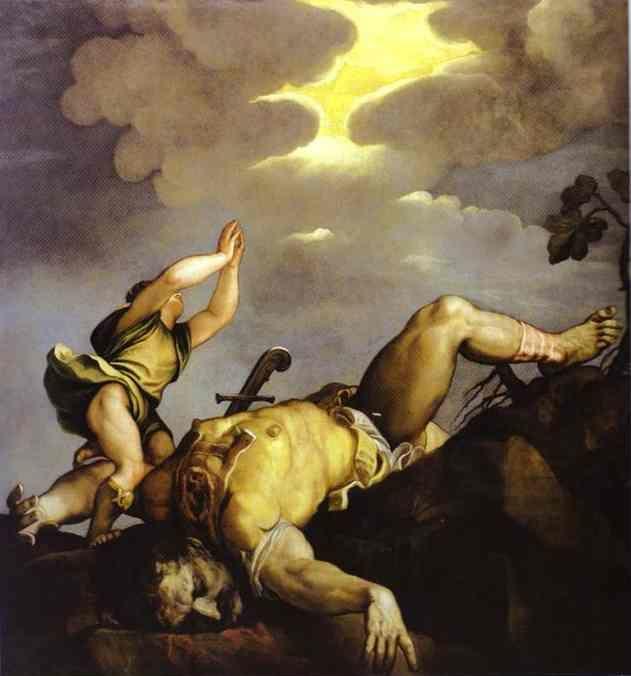
The Giant then runs at him, David picks up a stone and quickly slung it and it struck the Giant in the forehead, who fell facedown on the ground. Then David went and cut off the giants head and then the Israelites went and chased down the philistines, who ran from the field.

David remembered to give all glory to God, he knew that it was only through the LORD that he would be successful. He remembered to give glory to God. I think this is an essential part of being a Christian. Through both the hard times and the good times we should give glory to God. God wants to be both part of our celebrations of success in life and also in our times of grief or hardship God wants to be there grieving with us, comforting us and listening to us.
Also by having faith in the skills, in the character God has given us and trusting that God can use us for good works, we are actually giving him praise. God created us for a purpose, and he delights in seeing us fulfilling our purpose. One thing that God grieves is that many times we take the comfortable easy way, we take second best for our lives, sin, fall short of his glorious standard. But God delights in seeing his children fulfilling their potential, putting their trust in him and following his way for their life.
I love the story of David, his boldness to step up and do what God calls him to do. He sees that God does not like seeing his people and his name being dishonoured. David faces injustice with boldness and faith in God’s goodness and power.
Labels:
Church,
David,
Faith,
Heroes of Faith
Tuesday, November 13, 2007
Heroes of Faith - David - Part 1

The story of David one of the favourites for young boys, it tells the story of how a Shepard boy gets anointed king, slays a giant, plays the harp for his king, gets chased by his king in an attempt to get rid of him, develops a group of followers behind him, becomes king, then sees his family try to kill him. It’s the story of one of the greatest men of the bible, it tells of his strengths, faults, failings and how he honours God through his life. This series looks at David from my standing point, what I’ve learned from this man of faith, from the story of the bible that talks about him and how he related to those around him and to God.
The Underdog
We first meet David in Samuel 16 and this is the focus of this study.
Samuel has been called by God to go and anoint a new king to take leadership in Israel. This is because the king who he had anointed, Saul, had turned his back on God. Saul had started off strong, God had shown that he was his chosen in a series of signs (Read 1 Samuel 9 for the whole of this story), all he needed to do was follow God and honour him, but he had failed to follow Gods commands. But Saul fails to do so, Instead of waiting for Samuel at the battlefield, he made a burned offering up to God. Rather than waiting and following the command of Gods prophet and the desires of God, he gave up an offering to God out of his own will. The punishment was that he would lose control of Israel and his kingdom would not be established for all time.
So this and other actions would seal Saul’s fate, Saul’s faith in God was weak, he never trusted in God, he cared more about what others thought about him, than the fact that God had chosen him for the task of leading Israel, Gods people.
So Saul is rejected and Samuel goes on a search for a new leader, he is sent to the town of Bethlehem to Jesse by God. So Samuel goes to Bethlehem to the house of Jesse. Now Jesse lays out seven of his sons in front of Samuel and Samuel goes from oldest to youngest. The oldest Eliab is a strong strapping handsome lad and Samuel thinks to himself “surely this is Gods choice”, God, always the being of bluntness returns a reply “Do not consider his appearance or his height, for I have rejected him. The LORD does not look at the things that man looks at. Man looks at the outward appearance, but the Lord looks at the heart”
The same thing happens for the six other sons, Samuel is confused, a little bit disenchanted and wondering whether God is playing a game. He then clicks and thinks outside the box, he asks “are these all of your sons?
No there is one other, the youngest, David.
Samuel asks for him to be brought. David comes, he is only a boy, the youngest of the family, not the pick for King?
Then the LORD says “Rise and anoint him; he is the one.”
So God chooses the underdog, the youngest of a large family, David, who was not even invited to the first inspection.
This is something that God seems to be into doing, choosing someone to do his work who seems to be the least choice or the most undesirable choice the one who is too young (David and Timothy), exiled slaves (Daniel), a prostitute (Rahab), a fugitive (Moses) a concubine of a king (Esther), a Murderer of Christs followers (Saul) – Gods choices for those who he uses to do his will on earth are earth shattering, they destroy our preconceptions of who is chosen and why they are chosen, he uses those who are broken damaged vessels. He uses the underdog to do his will, shaping them, changing them and using them for just the right time.
This goes back to an idea earlier in the passage, where God says to Samuel:, “do not consider his appearance or his height… …. The Lord does not look at the things that man looks at. Man looks at the outward appearance, but the LORD looks at the heart.” This will be a point that we come back to further in this series on David. As we go through this journey on David we find that the name he is given by God is the “man after Gods own heart.” God early on sees the potential for greatness in this young boy, a scrawny boy who is that last one picked, but will turn into a great leader and man of God. Why is he a man after Gods own heart. Well in Hebrews 11 it describes that it was by faith that David would become all that he was. David had faith, unlike Saul, in God to shape him into a leader of a nation. David trusted in God, and trusted in the promises of God, he prayed to him and gave God the praise that he deserved. He had a sincere relationship with the God of the heavens, we can see this in the psalms that he wrote to God, he had a depth and understanding of God that I am jealous of. He realised that he was chosen, called to be a man of God, he was Chosen to change the world, chosen to administer justice and rule uprightly over his people, being both a military ruler but a spiritual example for his people.
So as we go through this journey we will try to look at the aspects of what faith is, what it really means have faith in God, what this means, why it changes us, how it changes us and what it means for the meaning of life , our identity, our destiny and our spirituality. We will continue on this journey in a couple of days, within the context of David the Giant killer.
Labels:
David,
Faith,
Heroes of Faith,
Old Testament
Thursday, October 11, 2007

Wednesday, October 10, 2007
My Wrestling with Worship
I've come to a point of wrestling with how I have seen worship, how I view Gods reality, I feel like it I'm shortchanging myself, or shortchanging God in how I've viewed what worship is.
Ok, so what do I essentially believe worship is, I believe it is honouring God with my life, acknowledging that he is that centre. I honour him and put God in the highest place in my life and in how I live. I want people to come into the throne room and see the whole train of his robe filling the room with Glory. I want people to know of the goodness of God, his righteousness and how he is just so amazing that I can not really describe him.
I also believe that Gods glory fills this present reality, but many times we cannot see it, that we fail to see his hand on creation, we fail to see his hand over our relationships with people, over life in general. We kind of steer away from this. Why?
I think its essentially that we have become very dualistic in our thinking, we separate the fact that God is in this present, the reality we inhabit right now, working and moving and challenging and changing us.
This comes from not having a wholistic view of Christianity. Many a times we limit "worship" to our Sunday morning songs at church. Do not get me wrong, I think songs are a form of communicating our relationship with God and thinking and mulling over what God has done for us, but we have to move from the worship session at church being about this. More problematic is that we can see the Sunday morning service as our spiritual "fix". A experiential drug, that frees us from the realities of the rest of the week. We live in the world, but feel like we become dirty by being in the world, the only way we can become clean is through our spiritual fix on Sunday morning. Our drug that gets us through the week. (This is a caricature I know, but it has some real impacts when you think about it.)
But worship is essentially our whole life, seeing the way we relate to people as being a spiritual activity, our work is a spiritual activity, me writing this is a spiritual activity. Many times we ignore that God is in our ordinary,day to day moments.
So why have I written this, why am I thinking this, where am I going with this.
I went along to a community of faith in the weekend where singing is not part of their worship, it might never be. But they want to see people come to know God and his reality. They have a heart for Wellington city and want to see it changed. This is really strange for a vineyard boy, a guy who has been brought up in a church that has led to loads and loads of new songs to the Lord. I know that we preach worship is all life but getting hold of this reality is really difficult sometimes and I've been struggling with it. I have essentially come to see singing as worship rather than seeing life as worship.
I am wrestling with this because it has again created a crisis in my thinking, what does worship look like, do I worship God in spirit and in truth, why has singing become so important to me, is it part of my cultural outlook rather than the reality I should live in?
What does it mean to say Jesus is Lord? What does it mean to see my whole life as worship, how does this look like moving forward? How do I become more wholistic in my faith experience?
More on this as time goes on!
Labels:
Church,
Discipleship,
Faith,
Worship,
Wrestling
My Apologies to the World!

Wednesday, October 03, 2007
ASBO Jesus
Ok, I thought I would attempt to lighten the mood a little with the help of a couple of cartoons from the adventures of ASBO Jesus. ASBO stands for Antisocial Behavioural Order and is given to misbehaving teens in the U.K.
H.T Dan Kimball


Friday, September 14, 2007
Beauty
This came from the Mosaic sermon "Beauty." This video is a metaphor for what Martin Luther called "the Great exchange, where Jesus took all the crap that we have done, and took it onto himself in the process of his death on the cross. The result was that we were given new life, we are given salvation. Hope you enjoy
Thursday, September 13, 2007
Becoming a Missional Christian
I wrote this post at the beginning of the year. Please forgive some of the repitition. It was written when I was processing through some stuff, this is actually not really that finished, but I want to share it with you because I was actually quite suprised to see how far this has played out in the way God is shaping me, it sums up how I'm attempting to live my life now as a christian sent out to the lost, sent to be a light, an example of something different, something fresh, something new! I will write further on contextualised faith, missional christianity, missional church and the missional God that we follow when I have some more time, but let this settle with you. Sorry about the intensity of this blog, again, it was written at a time of deep proccessing for me.
I have come to believe that a very important aspect of Christianity is that we are to be missional. A fact of Christianity is that it is a missional faith, we are called by our Saviour and Lord Jesus Christ to show people who God is, to show Jesus who Jesus is, and share with them the Truth of the Gospel. The last words spoken by Jesus in the Gospel of Matthew commanded Christians to spread the gospel throughout the world. Jesus said “Go to people of all nations and make them my disciples. Baptise them in the name of the Father, the Son and the Holy Spirit, and teach them to do everything I told you. I will be with you always, even until the end of the world. (Matt 28:19-20) Mission is to be a focus of Christians in the way they live and act, we are to fulfil Jesus’ commission. We are to tell people the Gospel through our words and deeds, just like Jesus did. We are here to bring about Gods redemptive plan on this earth. Not here to twiddle our fingers or debate how good our navels look. Jesus said that he was here on the earth to “tell the good news to the poor … …. to announce freedom for prisoners, to give sight to the blind, to free everyone who suffers.” (Luke 4:18 paraphrase) Throughout Jesus’ time on earth he did this and showed people that the way to salvation was not through trusting in our own actions, because frankly our good actions are like s%$%*y nappies when compared to Gods Holiness.(Isaiah 64:6) Salvation cannot be earned, it is given in act on unmerited favour to those who have faith in Christ (read Romans 3) as a result of the saving act of Jesus Christ on the cross.
So as Christians we are called to preach this truth, that God came to earth as the man Jesus Christ, lived a human life, died on a cross and then rose again and ascended into heaven, that the life that no man had ever lived and ever will live. Showing us that salvation is only through God, through having faith in God and his saving grace. But how do we do this practically through our lives. How do we centre our lives around these truths and preaching them in word and deed.
I’ve been thinking about this a lot lately and it scares me a lot, When I look at New Zealand I do not see a quarter acre, pavalova paradise, I see men and women crying out for something more, they live caught in addictions, making the wrong choices, getting drunk, living in unhealthy relationships, all of these are images of a broken nation, a nation which is not Gods Own.
So how are we to reach out and change New Zealand for the better, how are we going to change the world for the better?
I have come recently to discover that the way we need to do mission goes like this
First we need to figure out who Jesus really is, we need to figure out how he did mission, how it permeated his whole life. Read Mark, you do not find a guy who sits at his computer all day or reading books all day, he is out there, healing the sick, feeding the hungry, saving people from hell all the time, taking on the religious hypocrites of the age and kicking their butts. Read Luke, find out about how Jesus relates to people – he met them at their need. Man, he even used a drunken jewish wedding to show who he was to the people around him.
.
What I’m saying is that we need to know who Jesus really was, this is not based on our view of Jesus, in your preconceptions Jesus may be a hippy in a dress, but was he really that? Read, wrestle with what you find in the Gospels. I am coming to realise that Jesus is not a comfortable teacher that I follow. He was a radical, no-nonsense man, his words divided families and continues to divide families, it isn’t all roses. He wants us to be righteously-angry radicals willing to challenge the systems of injustice in our world. He doesn’t want us to act all high and mighty, he wants us to put all our trust in God, he wants us to do his will throughout the world and change this world for God.
Good Christology (In Laymans terms – how we view Christ’s and his saving actions) will lead to good missiology. As Christians we a called to be disciples of Jesus Christ. This means that we follow the example of our teacher. Our way of living should be incarnational. This will be a change from being evangelistic (I’m stealing these terms from Michael Frosts book Exiles) We are called to be in relationship with non-Christians on a equal footing. We are called to be Christ to our non-Christian friends. An example of truth and life to those who are non-christians. This means eating with non-christians, going out to pubs with non Christians, spending good quality time with non-christians, feeding them with the truth through our actions. It means we will have to stand up for what is truth when we are with them as well.
We are called to be different from the world, but what does this really mean. In contemporary Christian culture it has meant putting up walls, closing us up. We have not been allowed to form relationship with non-christians, and become separatist in our actions toward non-christians. This is not what Jesus has called us to do. He has called us to be ambassadors of the kingdom, going out into the cultures, subcultures etc and bringing the truth of the Gospel. We are not to be closed in, but reaching out with this truth, by living out the gospel.
So how are we to be examples of Christ in the world?
What does a culturally Relevant Church look like in Wellington?
What Churches in Wellington are doing mission well? What can we learn from them about doing mission in Wellington?
What is the culture of Wellington telling us about the concerns of the citizens of Wellington?
What are the Cultural Idols of Wellington? What are the Cultural Idols of New
Zealand?
We need men and women, godly, Christ centred men and women who will cry out “Give me New Zealand, or i’ll die”